You may think you don't need effect until... 🤯
This is the story of many problems my app hit over time, and how effect solved them one after the other with no effort 👇

You may think you don't need @EffectTS_ until Your AI is slow -> Stream Always same request -> Cache Requests hanging -> Timeout Requests failing -> Retry Unknown issue -> Observability All out of the box, in mostly 1 line of code each 💯
Slow AI: Streaming
For the initial MVP, it was easier to just make a "normal" API call, wait, and get back the full AI response.
That was already easy enough with
@effect/ai, using thegenerateObjectAPI 🪄
But then the prompt became more complex, and with it increased also the waiting time and user frustration.
Let's move to streaming then. Sounds complex? Well, it's mostly a single function change: from generateObject to streamText 💁🏼♂️
You get an effect
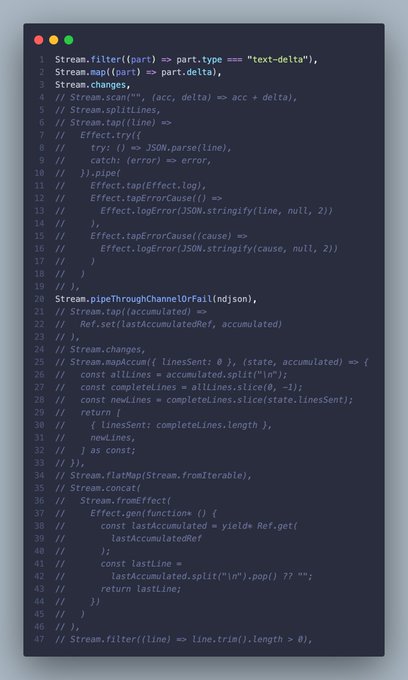
Stream, and theStreamAPI has all sort of mapping/filtering already available for you 🪄
Bonus: NDJSON
With streaming, a full structured JSON response doesn't fit anymore.
I want to parse/send an array of responses one by one, instead of waiting for the full JSON to complete 🤔
That's what NDJSON is for (Newline Delimited JSON).
I initially implemented my own Stream solution to parse NDJSON outputs, before effect solved this for me as well with the Ndjson module (@effect/platform).
One line change, and all works 💯
Typical @EffectTS_ experience 👇 Use the API to implement your solution, then discover that somewhere there is already a module for that, and replace all with 1 line 🪄
Scope and timeouts
I was integrating the Posthog API (analytics). The SDK requires calling shutdown to clean resources.
Easy with effect: using Scope and acquireRelease ✨
export class Posthog extends Effect.Service<Posthog>()("Posthog", {
  scoped: Effect.gen(function* () {
    const { apiKey, host } = yield* Config.all({
      apiKey: Config.redacted("POSTHOG_API_KEY"),
      host: Config.string("POSTHOG_API_HOST"),
    });

    const client = yield* Effect.acquireRelease(
      Effect.sync(
        () => new _PostHog(Redacted.value(apiKey), { host })
      ),
      (client) => Effect.promise(() => client.shutdown())
    );

    // ...
  }),
}) {}
But then I noticed another problem, what if shutdown itself gets stuck? 🤔
It theory it should be fast, but in practice you want to timeout if it takes too long for whatever reason 🤷🏼♂️
Again, one line change with effect and we are done, using Effect.timeout:
export class Posthog extends Effect.Service<Posthog>()("Posthog", {
  scoped: Effect.gen(function* () {
    const { apiKey, host } = yield* Config.all({
      apiKey: Config.redacted("POSTHOG_API_KEY"),
      host: Config.string("POSTHOG_API_HOST"),
    });

    const client = yield* Effect.acquireRelease(
      Effect.sync(
        () => new _PostHog(Redacted.value(apiKey), { host })
      ),
      (client) =>
        Effect.promise(() => client.shutdown()).pipe(
          Effect.timeout("2 seconds"),
          Effect.ignore
        )
    );

    // ...
  }),
}) {}
Caching
I am using the beforeLoad API of TanStack Router to verify the user status.
beforeLoadis called on eachLinkhover event, all the times, so it must be fast ⚡️
My beforeLoad was performing an API request, all the times, every time the same, for all hover events. Not good.
That's where caching comes in. And again, with effect is a one line change with withRequestCaching:
export const Route = createFileRoute("/_authenticated/_dashboard")({
  beforeLoad: async ({ context }) => {
    const { status } = await RuntimeClient.runPromise(
      Effect.gen(function* () {
        const apiRequest = yield* ApiRequest;
        const accessToken = yield* Auth.getToken(context.auth.getToken);
        return yield* Effect.request(
          new GetAccountStatus({ token: accessToken }),
          apiRequest.getAccountStatus
        ).pipe(
          Effect.withRequestCaching(true)
        );
      }).pipe(
        Effect.catchAll(() => Effect.dieMessage("Failed to get account status"))
      )
    );

    // ...
  },
// ...
Queue events
The Paddle client SDK (payments) provides a callback function to listen for events 🫠
I want to extract those events and pipe them to an
xstateactor 🤔
Well, effect 💁🏼♂️
With the Queue module I can push events to a queue, and then use Stream to send them to xstate:
export class Paddle extends Effect.Service<Paddle>()("Paddle", {
  effect: Effect.gen(function* () {
    const runtime = yield* Effect.runtime();
    const runPromise = Runtime.runPromise(runtime);

    const eventQueue = yield* Queue.unbounded<PaddleEventData>();

    const eventCallback = (event: PaddleEventData) => {
      void runPromise(Queue.offer(eventQueue, event));
    };

    const paddle = yield* Effect.promise(() =>
      initializePaddle({ token, environment: "sandbox", eventCallback })
    );

    return {
      eventStream: Stream.fromQueue(eventQueue),
      // ...
    };
  }),
}) {}
Stream.fromQueue gives me back a Stream, and I once again can use all the Stream API to send events to the xstate state machine 🪄
These are just a few examples. It's a testimony of how effect goes beyond error handling and dependency injection (which are huge wins already).
So, you probably do need effect after all 🤝
See you next 👋